Showing posts with label thesis. Show all posts

Saturday, 2 July 2011

RF Transceivers


Hi!

Long time without news, I'm sorry!
But now i'm fully ready to begin the development of my swarm of iRobots!

Today I will talk about the cheap RF transceivers I found at sparkfun (http://www.sparkfun.com/products/9582).
They are FM transceiver with configurable frequency bandwitch, SPI interface, internal FIFO (very small, but very useful). Right now I'm programming the eLua software to test them:

Here I'm using the STM32 kit to talk with two RFM12 (one on each SPI port) they will simply echo each other as a test application.
I will create soon a GITHub Repo to share the code of this post and futures ones!


Monday, 3 January 2011

Review: Swarm Robotics: From Sources of Inspiration to Domains of Application

As the first reviewed article I've chosen "'Sahin, Erol - Swarm Robotics" because it is a nice overview of the technology and tries do define swarm robotics as an area of robotics with very clear boundaries and goals.

The first part of the article is about motivation for studies, highlighting the three most praised characteristics of swarm systems, that are:
  • Robustness;
  • Flexibility;
  • Scalability.
After that comes a brief explanation about the ambitions of the work, saying it not pretend to be a formal definition of the area, but a guideline for future developments. Setting a nice statement as starting point:
"Swarm robotics is the study of how large number of relatively simple physically embodied agents can be designed such that a desired collective behavior emerges from the local interactions among agents and between the agents and the environment."

Then going through some points about autonomous robots such as:

  • Large number of robots;
  • Few homogenous groups of robots;
  • Relatively incapable or inefficient robots;
  • Robots with local sensing and communication capabilities.
The following topic is about sources of inspiration for swarm robotics and collective behavior in general, most of then biological with some very informative content about bacterial mechanisms and so on.

Finally some possible applications where swarms are highly recommended:

  • Tasks that cover a region;
  • Tasks that are too dangerous;
  • Tasks that scale-up or scale-down in time;
  • Tasks that require redundancy.
Ref: The article site at Springer Link (it can be downloaded under certain universities proxys) http://www.springerlink.com/content/cc4k8mdhbhk0uw3y/

Tuesday, 14 December 2010

Paper Review season is open!

While I do not solve the commercial problems with iRobot I will start the reviews of my project bibliography, I'm using Mendeley to organize the papers into categories and to classify notes about each one.
Until now my list is:

1. Beni G. From swarm intelligence to swarm robotics Sahin E, Spears WM, eds. Ant Colony Optimization and Swarm Intelligence Proceedings. 2005;3342:1-9. Available at: http://www.ncbi.nlm.nih.gov/entrez/query.fcgi?db=pubmed&cmd=Retrieve&dopt=AbstractPlus&list_uids=000228181500001.

2. Campo A, Nouyan S, Birattari M, Groß R, Dorigo M. Enhancing cooperative transport using negotiation of goal direction. Available at: http://citeseerx.ist.psu.edu/viewdoc/summary?doi=10.1.1.146.300.

3. Cao YU, Fukunaga AS, Kahng AB. Cooperative Mobile Robotics: Antecedents and Directions. 1997;4:226-234. Available at: http://citeseerx.ist.psu.edu/viewdoc/summary?doi=10.1.1.16.3358.

4. Ducatelle F, Di Caro A. G, Gambardella M. L. Cooperative Self-Organization in a Heterogeneous Swarm Robotic System. Available at: http://portal.acm.org/citation.cfm?id=1830501.

5. Ferrante E. A Control Architecture for a Heterogeneous Swarm of Robots: The Design of a Modular Behavior-based Architecture. 2009;(TR/IRIDIA/2009-010):77. Available at: http://iridia.ulb.ac.be/IridiaTrSeries/IridiaTr2009-010r001.pdf.

6. Garnier S, Gautrais J, Asadpour M, Jost C, Theraulaz G. Self-Organized Aggregation Triggers Collective Decision Making in a Group of Cockroach-Like Robots. Adaptive Behavior. 2009;17(2):109-133. Available at: http://adb.sagepub.com/cgi/content/abstract/17/2/109.

7. Holland O, Melhuish C. Stigmergy, Self-Organization, and Sorting in Collective Robotics. 2006. Available at: http://www.mitpressjournals.org/doi/abs/10.1162/106454699568737.

8. Kube CR. Collective Robotics: From Social Insects to Robots. Adaptive Behavior. 1993;2(2):189-218. Available at: http://adb.sagepub.com/cgi/content/abstract/2/2/189.

9. Kunz H, Hemelrijk CK, Intelligence A. Artificial Fish Schools: Collective Effects of School Size, Body Size, and Body Form. Available at: http://citeseerx.ist.psu.edu/viewdoc/summary?doi=10.1.1.139.6329.

10. Magnenat S, Rétornaz P, Noris B, Mondada F. Scripting the swarm: event-based control of microcontroller-based robots. In: SIMPAR 2008 Workshop Proceedings.; 2008. Available at: http://monicareggiani.net/simpar2008/StandardPlatform/scpr2008-03-Magnenat.pdf.

11. Magnenat S, Member S, Bonani M, Longchamp V, Mondada F. 1 ASEBA: A Modular Architecture for Event-Based Control of Complex Robots. Available at: http://citeseerx.ist.psu.edu/viewdoc/summary?doi=10.1.1.172.7935.

12. Mondada F, Bonani M, Magnenat S, Guignard A, Floreano D. Physical connections and cooperation in swarm robotics. Intelligent Autonomous Systems. 2004:53. Available at: http://books.google.com/books?hl=en&lr=&id=IKscPz-GaxAC&oi=fnd&pg=PA53&dq=Physical+connections+and+cooperation+in+swarm+robotics&ots=Asv3PFtmVg&sig=3sN6oMwiOjlowCvzvcmgZLSwkWE.

13. Nouyan S, Groß R, Dorigo M, et al. Group Transport along a Robot Chain in a Self-Organised Robot Colony. 2005:433-442. Available at: http://citeseerx.ist.psu.edu/viewdoc/summary?doi=10.1.1.60.4512.

14. Reynolds CW. Flocks, Herds, and Schools: A Distributed Behavioral Model. 1987:25-34. Available at: http://citeseerx.ist.psu.edu/viewdoc/summary?doi=10.1.1.48.7069.

15. Sahin E, Spears WM, Şahin E. Swarm Robotics. (Şahin E, Spears WM, eds.). Berlin, Heidelberg: Springer Berlin Heidelberg; 2005:10-20-20. Available at: http://www.springerlink.com/content/cc4k8mdhbhk0uw3y/.

16. Sharkey AJC. Swarm robotics and minimalism. Connection Science. 2007;19(3):245-260. Available at: http://www.informaworld.com/10.1080/09540090701584970.

17. Timmis J, Murray L, Neal M. A Neural-Endocrine Architecture for Foraging in Swarm Robotic Systems - Nature Inspired Cooperative Strategies for Optimization (NICSO 2010) - Studies in Computational Intelligence. Springer Berlin / Heidelberg; 2010:319-330-330. Available at: http://www.springerlink.com/content/u115n2635g1w9880/.

18. Şahin E, Winfield A. Special issue on swarm robotics. Swarm Intelligence. 2008;2(2-4):69-72. Available at: http://www.springerlink.com/index/10.1007/s11721-008-0020-6.

Wednesday, 1 December 2010

Hard to get iRobots

I've decided to use the iRobot Create on my project, even my advisor approved the platform, what is great!
But I simply can't buy them...
The Brazilian vendor ignore my e-mails and the international sales office automatically redirects my e-mails to the Brazilian office.

This situation is killing me.

Thursday, 28 October 2010

"Plant Neurobiology" : Smart vegetables

I've recently watched prof. Stefano Mancuso, from LINV, on TED.
He studies plant neurobiology, not sure if it's cosidered a "field",formaly speaking, but it sure deserves to be. He shows evidence of a collective intelligence in plants by analyzing electric signals an plant reactions, actions, networks etc.

Monday, 25 October 2010

Social Behavior on bacteria

A nice TED talk about bacterial communication by Bonnie Bassler. She studies how bacteria can communicate with one another, through chemical signals, to act as a unit. Her work could pave the way for new, more potent medicine.

Wednesday, 6 October 2010

The Big Fail

Ow no!

Miabots are out of stock and Merlin robotics ceased it production.
Now I'm out of robots, I will have to build my own swarm...
Wish me luck, I will need it!

Friday, 27 August 2010

MIT swarm of oil cleaners

Guys from the M.I.T. Senseable City Lab developed a swarm of oil cleaners based on solar energy. Very cool! (sorry the rush, I'm preparing the great news to put on the blog!)

Sunday, 13 June 2010

Presentation

Wow! Just finished my presentation for my project, I'll try to add it here to share.
Sadly it's in Portuguese by now:

Wednesday, 12 May 2010

Termites as constructors, not destroyers

People tend to hate termites (I would hate to have my house eaten too!) but they show us one of the most beautiful examples of emergent behavior, collective work and decentralized task management: the termite nest.

built of mud, sand, shi... well, soil. they are tall pillars that rise from the ground, they have inside fungus gardens, deposit chambers and even a royal chamber to the queen. But the most impressive is the air recycling system! totally emergent from construction (or do you think there is a special "architect" type of termite?! Or more basic, if they even know why they build in this way!)

Here is a youtube Video from a documentary that shows one of those marvels of insect world:


Friday, 7 May 2010

Emergence


Emergence is a phenomenon that intrigues me... It's quite easy to understand:
From the simple individual behavior of agents, acting locally, a global new behavior emerge from the swarm (possibly with different properties and characteristics).

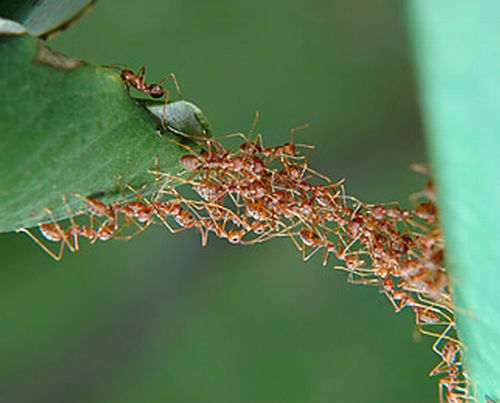
Consider an "Ant Bridge":


Each individual ant is acting based on some rule like:
"reach the edge, there hold the last one"

They really don't "know" they are making a bridge, they just do it.
Following this behavior they eventually reach the other side forming a bridge. So the bridge itself is an emergent sequel of a simple behavior that had nothing to do with bridges!

I consider those kind of solutions extremely beautiful, not only because it's generality, but because the fundamental behaviors are quite simple and the combination of locally aware agents following the same simple rule solve a much more complex problem.

Friday, 30 April 2010

Fancy name

Soon I will present my project aspirations to some faculty members, and they will decide if I can go on with it...
but I need a "long, fancy and Portuguese" name for it. it's a hard part.

I'm thinking in something like "Desenvolvimento e análise de uma plataforma para sistemas robóticos multi-agentes colaborativos" (Development and analysis of a platform for collaborative multi-agent robotic system). Too big, too fancy...I don't like it =/

Tuesday, 13 April 2010

A Modular Architecture for Event-Based Control of Complex Robots

This scary title is the title of a paper I've found on the internet these days.
It's pretty much useful for my research, I was thinking on ways to connect on an organized way a central controller (eLua based) and some "satellite" MCU's doing the dirty jobs (sensors low-level interface, motor control and so on...).

Here is a link, through Dr. Francesco Mondada from EPFL. (ASEBA)

Friday, 26 March 2010

On centralized control

Now, at the beginning of the project, I have to decide if I use a "emulated" local control or real local control.
By emulated I mean: Use a computer to send a low-level command (like "move foward" and so on) and emulate the local capabilities and knowledge of each agent on software or...
Real local control: Each robot have the complete control of it's action based on real local knowledge and processing.

I started creating a table of pros and cons of each approach to help me:

Emulated:

Pros:
  • Much simpler robots.
  • Much Cheaper robots (an important consideration, since I'm paying for them).
  • It's easier to convert the project to an academic competition (like RoboCup) since the architecture is closer.
  • more... (help me to think about this)
Cons:
  • Expend lot of time in Computer Vision, concurrence management, communication protocols, routing and other unrelated complex software.
  • Not real a swarm, since if the "brain" computer dies all agents stop...
  • Have to simulate sensors response.
  • more... (help me to think about this)
Real local:

Pros:
  • True local processing.
  • Real swarm, robust in case o failure of agents.
  • Focus on behavioral algorithms instead of a simulation platform.
  • Real challenge for my MCU programming skills (and eLua's power =) ).
  • more... (help me to think about this).
Cons:
  • More complex Hardware (electronics mainly).
  • Expensive agents.
  • More sensible to project errors (mostly a consequence of the complexity).
  • Turning away from other academic activities involving the built robots (again, something like RoboCup).
  • more... (help me to think about this)

Thursday, 25 March 2010

Warming up

This blog is an attempt to register the development of my MSc degree thesis on swarm robotics.
So expect little tutorials, news about robotics and some desperate calls for help when I get stuck!
Ah! Just in case, you can know more about me and my research at the links on the sidebar.

Not too much by now, but I expect this to be useful for someone! (It will be for me =])

Just to give a taste, one of my preferred swarm robotics projects. the Swarm-Bots :