I've recently watched prof. Stefano Mancuso, from LINV, on TED.
He studies plant neurobiology, not sure if it's cosidered a "field",formaly speaking, but it sure deserves to be. He shows evidence of a collective intelligence in plants by analyzing electric signals an plant reactions, actions, networks etc.
Showing posts with label philosophical discussion. Show all posts
Showing posts with label philosophical discussion. Show all posts
Thursday, 28 October 2010

Monday, 25 October 2010
Social Behavior on bacteria
A nice TED talk about bacterial communication by Bonnie Bassler. She studies how bacteria can communicate with one another, through chemical signals, to act as a unit. Her work could pave the way for new, more potent medicine.
Friday, 22 October 2010
Modular robotics now for sale
A very cool project from Cornell with modular articulated joints self-organizing robot now have a commercial similar version!
Check the video:
The commercial version is called Cubelets!

Check the video:
The commercial version is called Cubelets!

Tuesday, 1 June 2010
Complexity
Sorry for the long delay on posting, I'm kinda busy right now with several parallel projects and demands reaching deadlines (I hate those)...
Well, I'm really into complexity lately, found a nice book about complex systems (complex in a "standard" way, not the "mathematical" way with complex variables) talks about complexity on various kinds of dynamical systems: from thermal to demographics and economics, going through statistical physics!
My interest on complex systems is how the simple elements are organized (or self-organize) to give birth to their complex behavior, or how to develop agents with simple behaviors capable of control (or simple interact on a controlled way) with those systems.
Also, found a nice animation about our future and trillions of computers that has a proto-idea of "layered complexity", not very deep on this subject but I liked it:
Wednesday, 12 May 2010
Termites as constructors, not destroyers
People tend to hate termites (I would hate to have my house eaten too!) but they show us one of the most beautiful examples of emergent behavior, collective work and decentralized task management: the termite nest.
built of mud, sand, shi... well, soil. they are tall pillars that rise from the ground, they have inside fungus gardens, deposit chambers and even a royal chamber to the queen. But the most impressive is the air recycling system! totally emergent from construction (or do you think there is a special "architect" type of termite?! Or more basic, if they even know why they build in this way!)
Here is a youtube Video from a documentary that shows one of those marvels of insect world:
Friday, 7 May 2010
Emergence
Emergence is a phenomenon that intrigues me... It's quite easy to understand:
From the simple individual behavior of agents, acting locally, a global new behavior emerge from the swarm (possibly with different properties and characteristics).
Consider an "Ant Bridge":
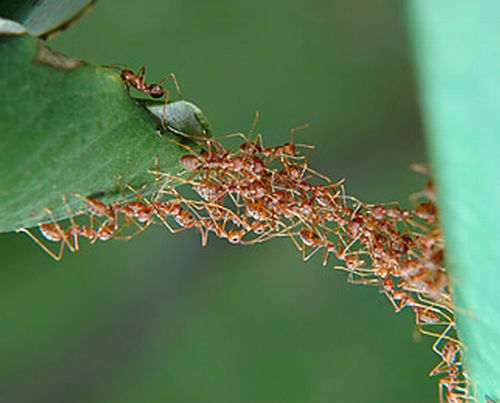
Each individual ant is acting based on some rule like:
"reach the edge, there hold the last one"
They really don't "know" they are making a bridge, they just do it.
Following this behavior they eventually reach the other side forming a bridge. So the bridge itself is an emergent sequel of a simple behavior that had nothing to do with bridges!
I consider those kind of solutions extremely beautiful, not only because it's generality, but because the fundamental behaviors are quite simple and the combination of locally aware agents following the same simple rule solve a much more complex problem.
Friday, 30 April 2010
Fancy name
Soon I will present my project aspirations to some faculty members, and they will decide if I can go on with it...
but I need a "long, fancy and Portuguese" name for it. it's a hard part.
I'm thinking in something like "Desenvolvimento e análise de uma plataforma para sistemas robóticos multi-agentes colaborativos" (Development and analysis of a platform for collaborative multi-agent robotic system). Too big, too fancy...I don't like it =/
Tuesday, 27 April 2010
Long Delay
Sorry for the long delay in posting! Those last weeks (including this one) had been tough...
But just to break the silence. A nice TED talk about one of my favorite themes: Biological inspired robotics. In this case locomotion:
Thursday, 8 April 2010
Eco-Tech, some say swarm is it's biggest triumph
Reading some tech news I've found an Autoworld entry about swarm technology.
It's kinda funny see that car industry is the most excited about swarm technology, but they have their point.
Here is the link to the article, very basic, but still interesting : http://blog.autoworld.com.my/index.php/2009/02/26/swarm-technology-the-biggest-contribution-to-eco-tech/
Friday, 26 March 2010
On centralized control
Now, at the beginning of the project, I have to decide if I use a "emulated" local control or real local control.
By emulated I mean: Use a computer to send a low-level command (like "move foward" and so on) and emulate the local capabilities and knowledge of each agent on software or...
Real local control: Each robot have the complete control of it's action based on real local knowledge and processing.
I started creating a table of pros and cons of each approach to help me:
Emulated:
Pros:
Pros:
By emulated I mean: Use a computer to send a low-level command (like "move foward" and so on) and emulate the local capabilities and knowledge of each agent on software or...
Real local control: Each robot have the complete control of it's action based on real local knowledge and processing.
I started creating a table of pros and cons of each approach to help me:
Emulated:
Pros:
- Much simpler robots.
- Much Cheaper robots (an important consideration, since I'm paying for them).
- It's easier to convert the project to an academic competition (like RoboCup) since the architecture is closer.
- more... (help me to think about this)
- Expend lot of time in Computer Vision, concurrence management, communication protocols, routing and other unrelated complex software.
- Not real a swarm, since if the "brain" computer dies all agents stop...
- Have to simulate sensors response.
- more... (help me to think about this)
Pros:
- True local processing.
- Real swarm, robust in case o failure of agents.
- Focus on behavioral algorithms instead of a simulation platform.
- Real challenge for my MCU programming skills (and eLua's power =) ).
- more... (help me to think about this).
- More complex Hardware (electronics mainly).
- Expensive agents.
- More sensible to project errors (mostly a consequence of the complexity).
- Turning away from other academic activities involving the built robots (again, something like RoboCup).
- more... (help me to think about this)
Subscribe to:
Posts (Atom)


 Posts

